What next?
The general case. These apply the same maths to the specific thing you are borrowing for.
External links are marked and open in a new tab. We are not a broker and receive no commission on any credit you take out.
What your result means
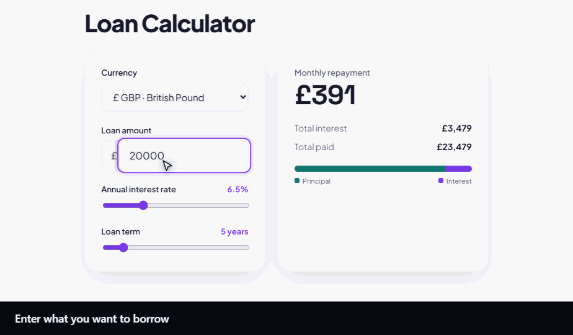
Your monthly repayment is the fixed amount you pay every month until the loan clears. Total interest is what the borrowing costs on top of the amount borrowed, and total paid is the two combined. The split bar shows how much of your payments attacks the debt versus interest. Figures assume a fixed rate for the whole term and exclude arrangement fees, insurance and early-repayment charges — add those when comparing real offers.
Why this one is different
The worked example below is computed by script against the live tool, so the numbers on this page are proven to match what the calculator produces. Fifteen common loan amounts and terms are worked through in full on a linked comparison page, so you can check a scenario close to yours before entering your own.
The first year of a loan barely dents what you owe
It feels unfair, but it’s just maths: early payments are mostly interest because interest is charged on a big remaining balance. Only later does the balance shrink fast. Seeing this split is the difference between dreading a loan and managing it.
A slightly shorter term or a small regular overpayment attacks the principal directly and can save a surprising amount in total interest — often more than shopping around for a marginally lower rate.
How it works
A fixed-rate loan is repaid in equal monthly instalments over the term. Early payments are mostly interest; later payments are mostly principal. This calculator uses the standard amortisation formula to find the fixed monthly amount that clears the balance exactly by the final payment.
How to use this calculator
- Choose your currency.
- Enter the loan amount you want to borrow.
- Set the annual interest rate and term in years with the sliders.
- Read your monthly repayment, plus total interest and total paid, and the principal-vs-interest split.
Watch it in action
A loan of £35,000 at 8.9% over 3 years — entering the amount, dragging the rate and term, and reading the monthly repayment.
Recorded from this page, not a mock-up. The steps below say the same thing in words.
Formula
P = loan amount, r = monthly interest rate (annual ÷ 12), n = number of monthly payments.
Example calculation
A £20,000 loan at 6.5% over 5 years:
Total interest ≈ £3,479
Total paid ≈ £23,479
Frequently asked questions
Does this include fees?+
No. It calculates repayments on the principal and interest only. Arrangement fees, insurance or early-repayment charges are not included — add them separately when comparing offers.
What is APR vs interest rate?+
APR bundles the interest rate together with mandatory fees to show the true yearly cost. Use APR to compare loans; use the interest rate here to estimate repayments.
Can I overpay, and how much does it save?+
An overpayment goes entirely against the principal, so it removes both that amount of debt and all the interest it would have accrued for the rest of the term. Timing matters more than size: the same payment made in year two of a long loan saves far more than it would in the final years. Check your agreement for early repayment charges first.
What happens if I miss a payment?+
Interest continues to accrue on the outstanding balance, so the total cost rises and the schedule no longer matches this calculation. Most lenders also apply a fee and report the missed payment to credit reference agencies. Contact the lender before missing a payment rather than after.
Why is the total interest so much larger than I expected?+
Because interest is charged on the outstanding balance every period, and early in the term that balance is nearly the whole loan. On a long term the total interest can approach or exceed the amount borrowed. Shortening the term is the most effective way to reduce it, at the cost of a higher monthly payment.
Related calculators
What the term and the rate do to a loan
Both tables use the calculator’s own model: equal monthly payments, interest charged monthly at one twelfth of the annual rate, and no fees. Every cell is a £10,000 loan, so you can compare rates across the page and terms down it.
Monthly payment
| Term | 4% | 7% | 10% | 15% | 20% |
|---|---|---|---|---|---|
| 2 years | £434 | £448 | £461 | £485 | £509 |
| 3 years | £295 | £309 | £323 | £347 | £372 |
| 5 years | £184 | £198 | £212 | £238 | £265 |
| 7 years | £137 | £151 | £166 | £193 | £222 |
Total interest
| Term | 4% | 7% | 10% | 15% | 20% |
|---|---|---|---|---|---|
| 2 years | £422 | £745 | £1,075 | £1,637 | £2,215 |
| 3 years | £629 | £1,116 | £1,616 | £2,480 | £3,379 |
| 5 years | £1,050 | £1,881 | £2,748 | £4,274 | £5,896 |
| 7 years | £1,482 | £2,678 | £3,945 | £6,209 | £8,653 |
At 10% over five years the payment is £212 a month; squeeze the same loan into two years and it rises to £461. The shorter loan feels harder every month but costs £1,673 less in interest (£2,748 against £1,075). The shape is the same at every rate: a longer term lowers the payment and raises the cost.
Rate matters more as the term grows. On a seven-year loan, going from 7% to 15% adds £3,531 of interest on £10,000 borrowed.
Five loan mistakes to avoid
- Choosing by monthly payment alone. The lowest payment is usually the longest term, which is the most expensive. Look at total interest as well, using the second table.
- Mixing up the interest rate and the APR. The APR includes mandatory fees and is the figure to compare between lenders. The calculator uses the interest rate you enter, so add any fees separately.
- Trusting the advertised rate. Lenders advertise a “representative” APR, which only a share of successful applicants must receive. Your offered rate depends on your credit record and can be higher. Check the rate in your actual offer before you compare.
- Ignoring early repayment terms. Paying a loan off early saves interest, but some agreements charge for it. Read the settlement terms before overpaying.
- Borrowing for longer than the thing lasts. A seven-year loan on something you will replace in three leaves you paying for it after it has gone.
Assumptions & limitations
Every figure here comes from a simplified model. Keep these limits in mind when reading your result:
- Assumes a fixed interest rate and equal monthly payments for the whole term.
- Ignores arrangement fees, insurance and early-repayment charges.
- Your lender’s advertised APR may differ from the rate you enter.
Further reading
Formula & reference
Worked answers for common amounts
Each of these shows the repayment, the working and the same loan compared across terms and rates. They open with the figures already filled in.