What next?
The general converter. These are the specific ones people go to next.
How to use this converter
- Choose a measurement category.
- Enter a value and pick the from and to units.
- Read the conversion.
Watch it in action
Converting metres to feet — picking a category, entering a value and choosing the units.
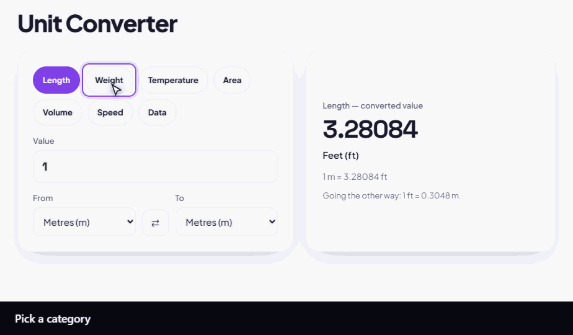
Recorded from this page, not a mock-up. The steps below say the same thing in words.
One home for every unit conversion
Measurement units are scattered across metric and imperial systems, and most people only need a handful at a time. This page collects every Tool Corner converter in one place so you can jump straight to the one you need — length, weight, temperature, area, volume, speed and data storage.
Each converter is instant, works offline in your browser, and shows a full comparison table so you can read one value across every unit at once. Nothing you type is ever sent to a server.
What your result means
Whichever category you pick, the result is the same physical quantity expressed differently — the conversion never changes what you measured, only the label on it. Every factor here is either exact by international definition (the inch, the pound, the nautical mile) or derived from one that is.
The one thing to watch is precision. This tool shows several decimal places because some conversions genuinely need them, but your answer can never be more accurate than your input. If you typed a rounded figure, round the output to match rather than copying every digit into a quote or a spec.
Why this one is different
This one refuses impossible conversions instead of returning a number anyway: negative Kelvin is rejected, non-numeric input gets a plain instruction, and units from different categories are never silently bridged. The factor line names the ratio being applied, so the answer can be checked without trusting the tool.
Why the tool refuses to convert litres into kilograms
It is the request people most often want and the one a general converter should not answer, because the conversion is not a property of the units — it is a property of the substance. A litre of water is 1 kg, a litre of milk about 1.03, a litre of olive oil 0.92, a litre of plain flour roughly 0.53. Without a density there is no single right answer, and a converter that picked one would be silently wrong for everything else.
The same reasoning applies to torque and energy, which share the unit newton-metre but are not interchangeable, and to fluid ounces and ounces, which measure volume and weight respectively and coincide only for water. Keeping the families separate is what makes the results trustworthy.
What the tool does do is carry full precision through the calculation and round only for display, so chaining conversions does not accumulate error. Convert metres to feet to inches and back and you will land on the number you started with, which is not true of a converter that rounds at each step.
Frequently asked questions
Are these conversions exact?+
Yes. Every converter uses the internationally defined conversion factors (for example, one inch is exactly 25.4 mm), so results are accurate to the precision shown.
Do I need to install anything?+
No. All converters run entirely in your browser, work on phone and desktop, and need no sign-up or download.
Which unit families does this cover?+
Length, weight and mass, volume, area, temperature, speed and data storage. Each family has its own dedicated converter if you want a page focused on one.
Does it convert between incompatible units?+
No, and deliberately so. Converting litres to kilograms needs a density, which depends on the substance, so the tool keeps each family separate rather than guessing.
How is rounding handled?+
Values are shown to a sensible number of significant figures for the magnitude involved. The underlying calculation uses full precision, so chained conversions do not accumulate rounding error.
Does it work offline?+
Once the page has loaded, yes. All conversion factors are built into the page and nothing is sent to a server.
Related converters
Further reading
Most-used conversions
The factors that come up most often, across every category in this converter.
Worked example
Say you want 5 kilometres in miles. Pick Length, enter 5, set from to kilometres and to to miles.
- 5 km × 1,000 = 5,000 m (into the base unit)
- 5,000 m ÷ 1,609.344 = 3.10686 miles
Temperature is the exception: the scales have different zero points, so the tool applies a formula rather than a single factor. 180 °F becomes (180 − 32) × 5 ÷ 9 = 82.2222 °C.
Assumptions & limitations
One converter covering many categories comes with a few caveats:
- Conversions only make sense within a category — length to length, mass to mass. Converting litres to kilograms requires the density of the specific substance, which this tool does not know.
- Where US and imperial units share a name but not a size (gallons, pints, tons, fluid ounces), check which system a source figure uses before converting.
- All factors follow the international definitions published by NIST and BIPM; almost all of them are exact rather than measured.
- Results are rounded for display only — full precision is retained in the calculation.